
I burned through bulky bricks and then tried GaN and saw big practical gains.
A 65W GaN charger gives compact, efficient charging for phones, tablets, and many laptops, but you must match device needs, cables, and port distribution.
a 65W GaN charger is a great all-rounder for most users, but check device wattage, cable rating, and how you plan to use ports.
Stop if you only want the quick view. Read on for functions, comparisons, USB-C behavior, safety, and buying tips.
What are the functions of a 65W GaN charger?
I picked a 65W GaN charger and saw it run my phone, tablet, and laptop without extra bricks.
A 65W GaN charger delivers up to 65 watts total, supports USB‑PD and often PPS, offers multiple ports, and manages heat more efficiently than silicon chargers.
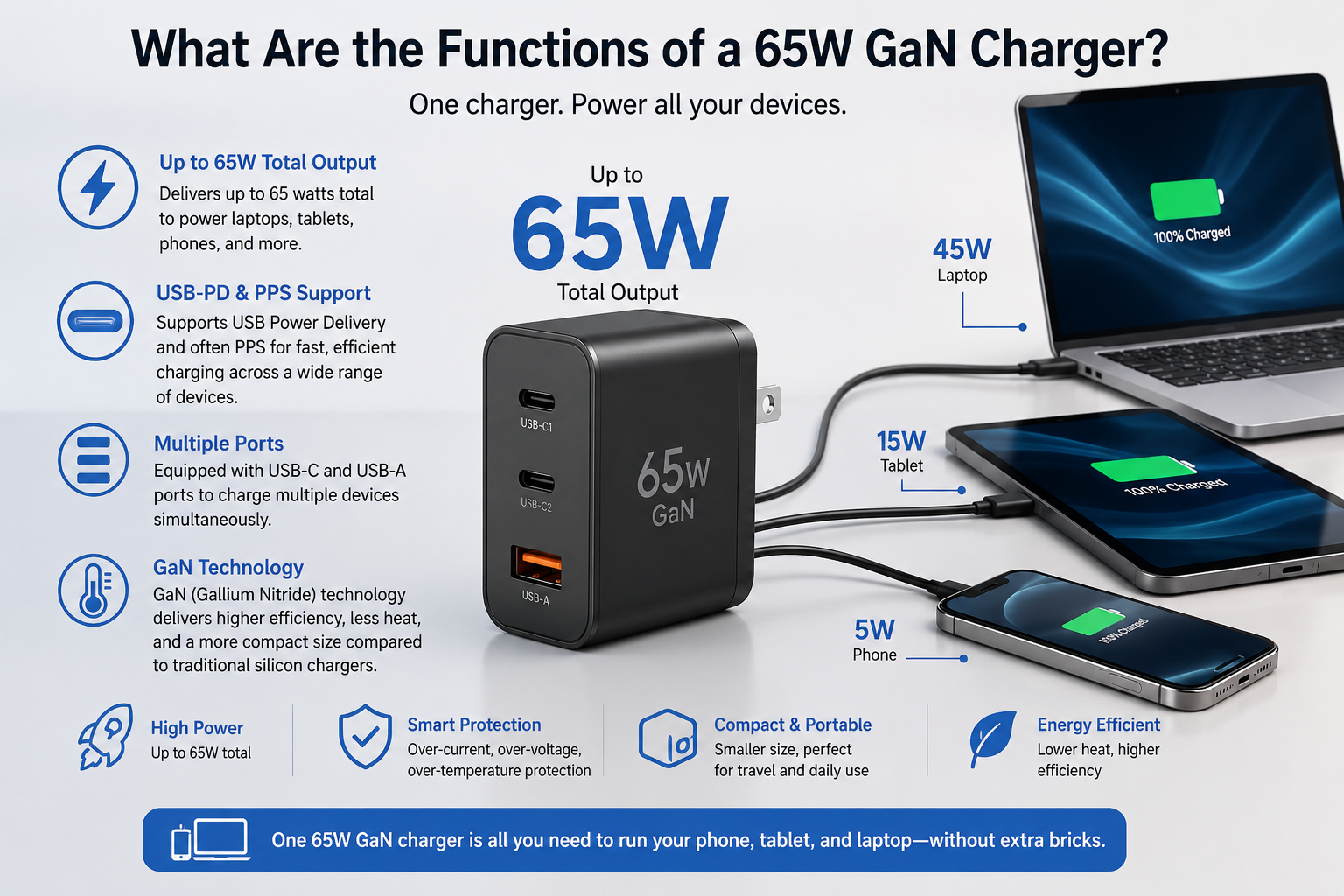
I use mine for fast phone top-ups, tablet work, and light laptop tasks while traveling.
A 65W GaN charger typically includes at least one USB-C PD port. Many include a second USB-C or USB-A port. The charger negotiates voltage and current using USB Power Delivery. Some models add PPS for finer voltage steps and cooler charging. A single device can draw up to 65W if the charger is single‑port. With multiple devices, the charger shares power based on per-port specs and negotiation. GaN technology enables high switching frequency and lower losses. That keeps the charger compact and cooler. The charger also includes protections: over‑voltage, over‑current, short‑circuit, and thermal shutdown. Some models add intelligent port recognition to allocate power efficiently. The net result is fewer bricks, faster top-ups, and a smaller travel footprint.
Comparison of 65W GaN charger and ordinary power adapter
I switched from a large 65W brick to a GaN model and felt the size and heat difference immediately.
GaN chargers are smaller, run cooler, and often support multiport PD/PPS. Ordinary adapters are bulkier, less efficient, and may lack multiport or high-watt support.
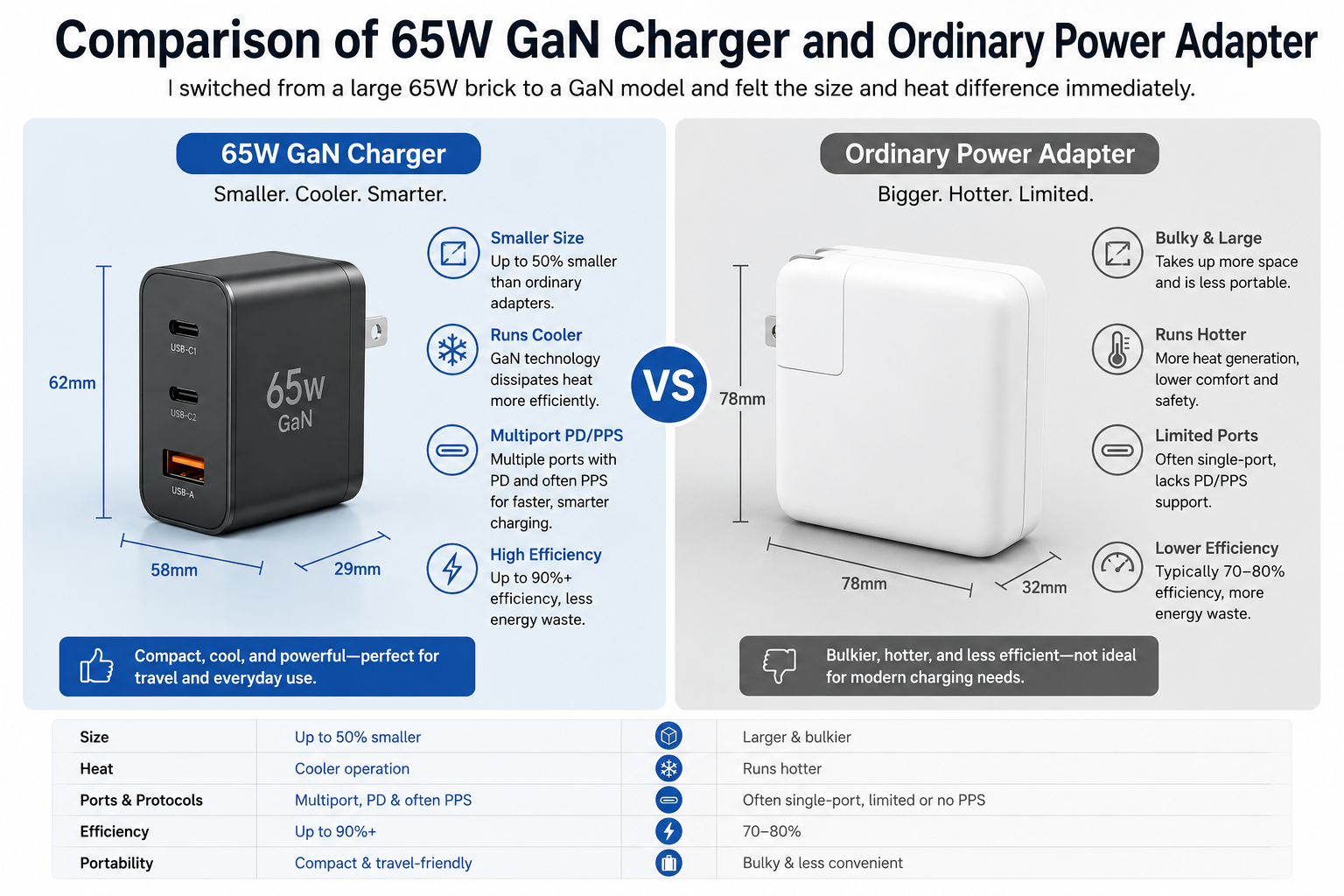
I now carry one GaN charger instead of two older adapters.
Key differences:
- Size and weight: GaN chargers are much smaller for the same wattage. They fit in pockets easier.
- Efficiency: GaN parts switch faster with less heat loss. Ordinary silicon designs run hotter and waste more energy.
- Multiport capability: Many 65W GaN units support 2–3 ports with smart power distribution. Older single-port bricks offer fewer options.
- Heat management: GaN stays cooler under load, reducing thermal throttling risk. Standard adapters may throttle earlier.
- Smart protocols: Modern GaN models usually support USB-PD and PPS. Older adapters may only support fixed voltages or slower protocols.
- Cost: GaN chargers cost more than basic adapters but often less than multiple OEM bricks.
- Safety features: Reputable GaN chargers include protections similar to good adapters. Cheap GaN clones may cut corners.
If you need a single compact charger for a phone and a laptop or travel light, a 65W GaN charger is a clear win. If you only ever charge a small phone and have no need for multiport or laptop charging, a simple low-watt adapter may be cheaper.
How Does a 65W GaN Charger USB C Work?
I opened spec sheets and tested a GaN charger to see how the USB‑C port behaves under load.
The USB‑C port uses USB Power Delivery to negotiate voltage and current. GaN components handle high-frequency switching to deliver up to 65W efficiently and with lower heat.
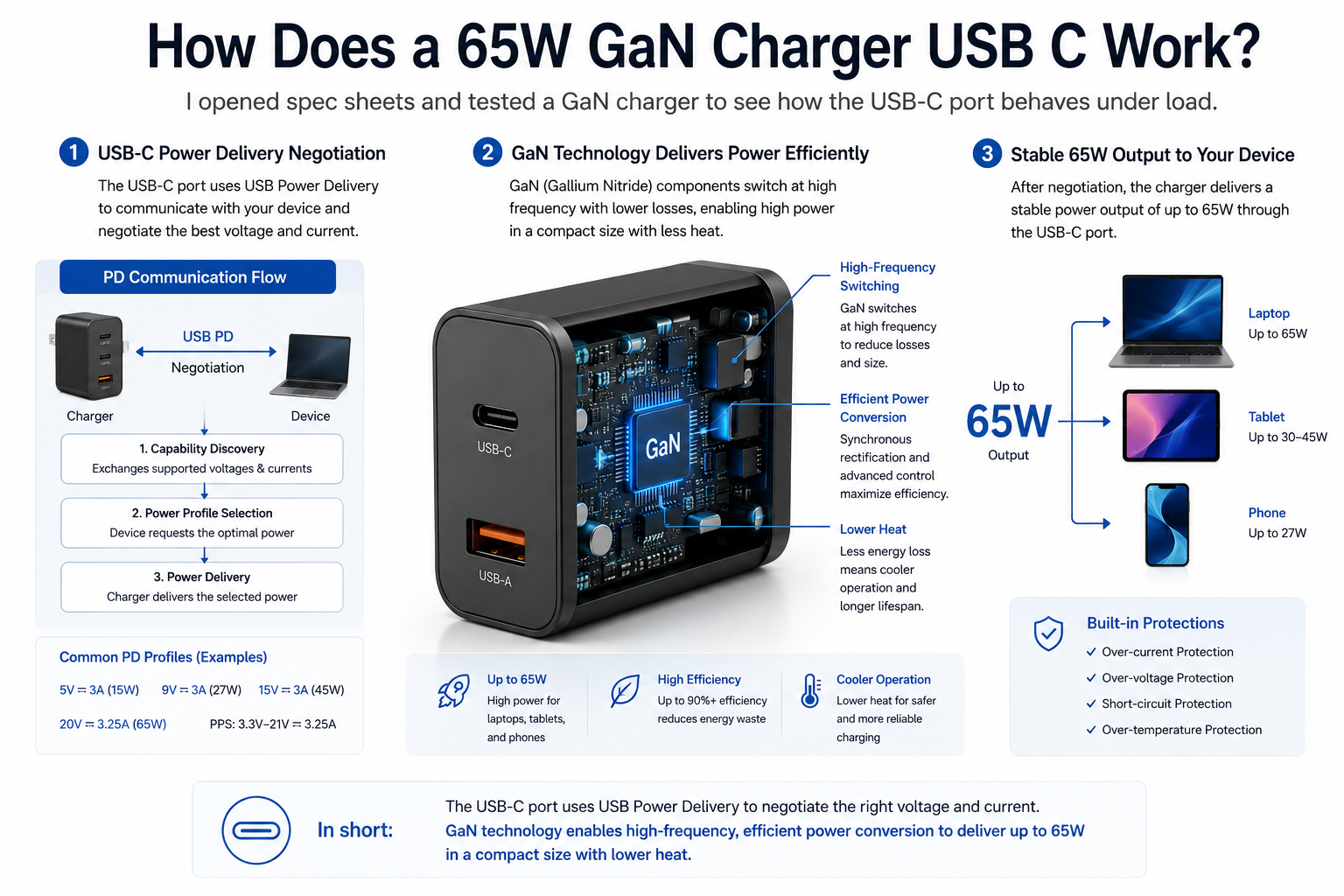
I saw my laptop request 45W and the charger respond instantly at the right voltage.
Operation details:
- Handshake: When you plug in a device, the charger and device exchange PD messages. They agree on a voltage (5V/9V/15V/20V) and current up to 65W total.
- PPS: If both sides support PPS, the charger can offer a range of voltages in small steps. The device requests the exact value for better efficiency.
- Power sharing: In multiport chargers, an internal power manager divides the 65W among ports. The total output never exceeds the rated 65W.
- Thermal control: GaN switches run hotter at high frequency but overall waste less heat. The charger uses thermal monitoring to reduce output if temperatures rise.
- Cable role: The USB-C cable must be rated for the current/voltage. For >60W use, a cable with e-marker and 5A rating is recommended. Cheap cables can drop voltage and heat up under load.
- Protection: The charger includes OVP, OCP, OTP, and short-circuit protection. These protect the charger and devices during faults.
In short, the USB‑C port behaves like any modern PD port, but GaN internals make it smaller and more efficient.
How safe is the USB-C port on a 65W GaN charger?
I read safety standards and inspected builds to evaluate real-world risk.
A quality 65W GaN charger is safe when made to standards. Look for safety certifications, quality components, and tested firmware. Cheap or unbranded units are the main risk.
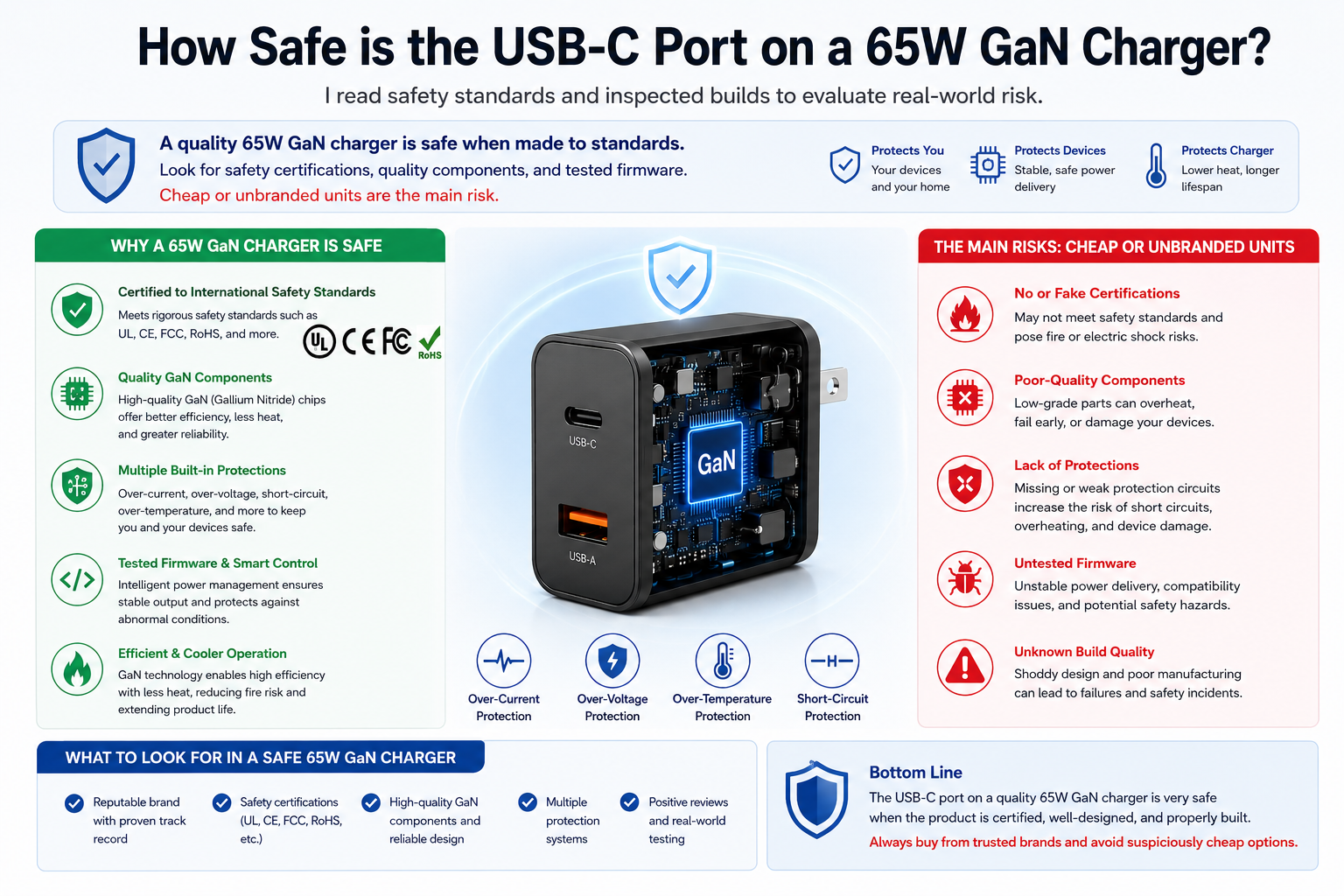
I only buy chargers with recognized marks and clear test reports.
Safety points to check:
- Certifications: Look for UL, ETL, CE, FCC, or TUV marks. USB‑IF certification is a plus for PD compliance.
- Component quality: Good brands disclose GaN suppliers, capacitors, and protections. Cheap clones may use substandard parts.
- Protections: Ensure the charger lists OVP, OCP, OTP, SCP. These cut power during faults.
- Firmware and updates: Some smart chargers use firmware for power sharing and safety. Reputable makers test firmware thoroughly.
- Thermal design: Metal enclosures or vents help dissipate heat. GaN chips reduce heat but do not eliminate it.
- Cable safety: Use certified cables. The weakest link can be the cable, not the charger. Cables without e‑marker chips can limit or misreport current capacity.
- Real-world checks: Read user reviews for reports of overheating, failures, or voltage problems. Avoid models with many negative reports.
If you follow these checks, the USB‑C port on a 65W GaN charger is as safe as most modern chargers. Buying from known brands reduces risk.
Practical buying and usage tips
I keep a short checklist before buying and using a 65W GaN charger.
- Confirm device wattage needs. Don’t overpay for unused power.
- Choose PD with PPS support for best efficiency and lower heat.
- Use high-quality USB-C cables rated for 5A / 100W when needed. Prefer e-marker cables for high wattage.
- Check per-port specs for multiport chargers to know how power splits.
- Buy from reputable brands with safety certifications and clear warranties.
- Prefer GaN chargers with good thermal design and user reviews showing reliability.
- Use surge protectors or power strips for unstable power environments.
Conclusion
A 65W GaN charger is an excellent choice for many users. It offers compact size, efficient PD/PPS charging, and multi-device convenience if you pick a reputable, certified unit.