
Is higher wattage better for a mobile phone charger?
I saw people assume bigger numbers always mean faster charging.
Higher wattage means the charger can supply more power, but the phone only takes what it supports.1 A higher-watt charger is useful if you want flexibility for other devices, but it does not automatically make every phone charge faster.
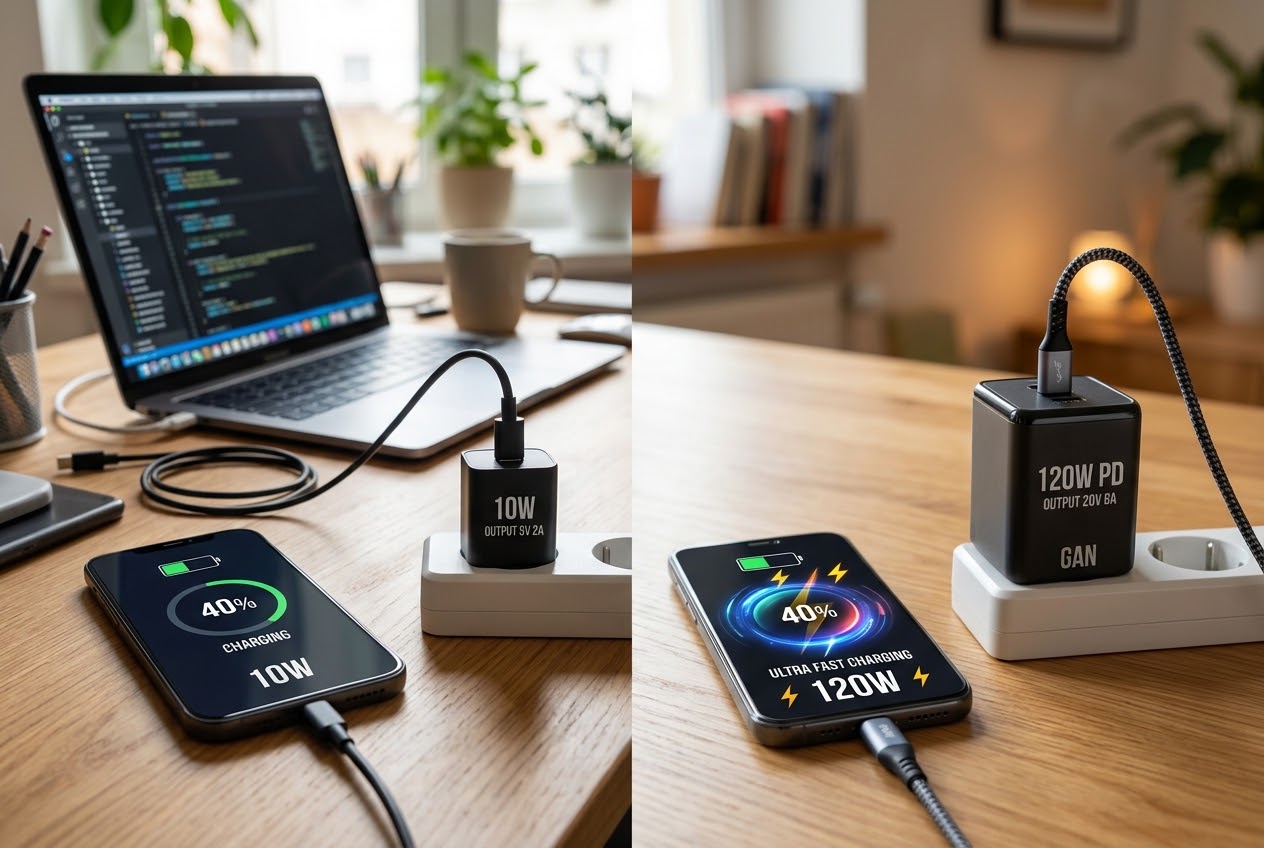
I choose chargers that match my devices, not the biggest number.
How wattage works:
- Wattage equals voltage times current. Chargers list their maximum output, like 18W, 30W, or 65W.
- Device negotiation: Modern phones use a protocol such as USB Power Delivery to ask the charger for a safe voltage and current. The phone sets the actual power draw.
- Headroom and flexibility: A higher-watt charger gives headroom. It can supply full power to a phone and still charge a tablet or laptop on another port. That reduces slowdowns when multiple devices charge.
- Efficiency and heat: Higher-watt chargers may be more efficient if well designed. But fast charging creates heat in the phone. The phone will reduce charging speed if it gets too hot.
- Cost and size: Higher-watt GaN chargers can be compact and handy. But they cost more. If you only ever charge one phone, you do not need an oversized charger.
- Safety: Certified high-watt chargers from reputable brands follow safety tests. Cheap high-watt units may skip protections and risk damage.
In short, higher wattage is better for flexibility and multi-device use. It does not force a phone to charge faster than it can accept.
Do higher watt chargers damage battery?
I worried about battery health when I first used fast chargers.
A proper high-watt charger will not damage the battery by itself. Phones and chargers use smart negotiation and thermal management. Damage occurs mainly from poor-quality chargers, extreme heat, or constant aggressive charging behaviors.
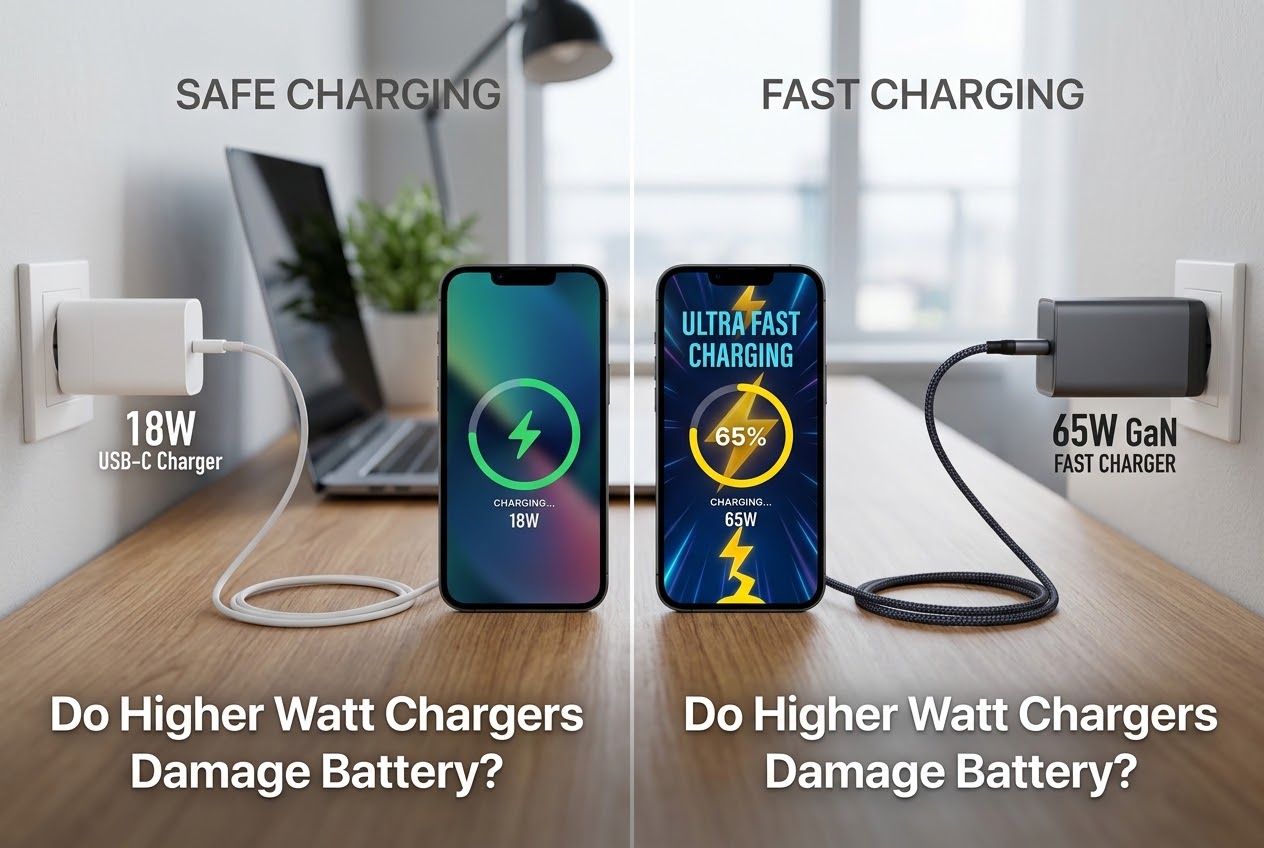
I avoid cheap chargers and watch phone temperature during fast charging.
Why high-watt chargers are usually safe:
- Negotiation and limits: Phones negotiate power with the charger.2 They draw only safe current and voltage levels. The charger cannot force more power than the phone accepts when both use a standard protocol.
- Thermal protection: Phone firmware throttles charging if temperatures rise. This lowers charge speed to protect the battery.
- Quality matters: Reputable chargers include protections for over-voltage, over-current, short circuits, and overheating. Cheap units may lack these, risking damage.
- Battery chemistry: Lithium-ion batteries age from charge cycles, heat, and deep discharge. Fast charging increases temperature slightly, which can speed aging over many cycles. The effect is gradual, not immediate.
- Best practices: Use certified chargers and cables. Avoid charging in hot places. Remove thick cases during fast charging if the phone gets hot. Do not leave the phone under direct sun or heavy CPU load while charging.
- Manufacturer controls: Many phone makers test and tune charging curves to balance speed and battery longevity. They limit peak current and add adaptive charging features.
In practice, a quality high-watt charger with correct protocols is safe. Avoid no-name chargers and manage heat for long battery life.
How many watts is fast charging iPhone?
I compared manufacturer notes and real-world tests of recent iPhones.
Fast charging on iPhones is achieved with USB Power Delivery and typically needs a charger that can provide 18W or more. For best real-world speed, 20W–35W PD chargers are common recommendations.
I use a 45W PD charger for quick top-ups and larger chargers for multi-device use.
What counts as fast charging:
- Official baseline: Apple historically recommended a 20W USB-C PD charger to enable fast charging on many iPhone models. That yields a substantial speed-up compared to 5W or 12W adapters.
- Real-world gains: With a 20W PD charger you often get about 50% charge in roughly 30 minutes on supported iPhones, depending on battery level and usage. Results vary by model and conditions.
- Higher wattages: Chargers rated 60W–65W or more can also deliver fast charging. The phone negotiates safe power, so a 30W charger does not damage the phone. It can give the same or slightly improved curves depending on phone design.
- Wireless vs wired: Wireless fast charging is slower than wired. Qi and MagSafe wireless top speeds are lower than wired PD. Wired PD remains the fastest practical method for iPhones.
In summary, 18W is the lower bound historically, and 20W+ is the practical target for fast wired charging on iPhones.
Best wattage for iPhone 18 charger
I reviewed charging specs and user needs to recommend an optimal wattage.
For the iPhone 18, I recommend a 60W–65W USB-C PD charger as the best balance of speed, cost, and flexibility. A 30W charger still gives fast charging, but 60W–65W offers extra headroom and works well with multiport chargers.
I use a 30W GaN PD charger daily and a 65W multiport for travel with a laptop.
Why 60W–65W is a good pick:
-
Speed: This range gives fast wired charging and often shortens top-up time over a 45W charger in real tests. The phone negotiates power safely.
-
Flexibility: A 60W–65W charger covers phones, tablets, and smaller laptops. It works well for multiport chargers that split power.
-
Size and cost: GaN chargers in this wattage are compact and affordable compared to old brick-style adapters.
-
Thermal and battery health: This wattage avoids extreme currents while still being fast. The phone controls charging to manage heat and battery care.
-
Cable: Use a quality USB-C to USB-C cable rated for the charger’s wattage. For multiport setups, check how the charger allocates power. Some units reduce per-port power when multiple devices connect.
Conclusion
Higher wattage does not automatically mean faster charging, but it does provide greater flexibility and compatibility across multiple devices. Modern smartphones control how much power they receive, making reputable high-wattage chargers safe for battery health.
For most iPhone users, a 20W to 30W USB-C PD charger delivers the best balance of charging speed, efficiency, and convenience. Users with multiple devices may benefit from a 35W dual-port charger or a 65W GaN charger for an all-in-one charging solution.
-
"Quick Charge – Wikipedia", https://en.wikipedia.org/wiki/Quick_Charge. This source explains how modern smartphones negotiate power with chargers, ensuring they only draw what they can safely handle. Evidence role: mechanism; source type: education. Supports: Higher wattage chargers do not automatically make every phone charge faster.. ↩
-
"USB PD Negotiation Explained: How USB-C Devices Agree on Power", https://asmr.education/faq/usb-c/usb-power-delivery-negotiation-process. This source explains the negotiation process between phones and chargers to ensure safe power delivery. Evidence role: mechanism; source type: education. Supports: Phones negotiate power with chargers to ensure safe charging.. ↩